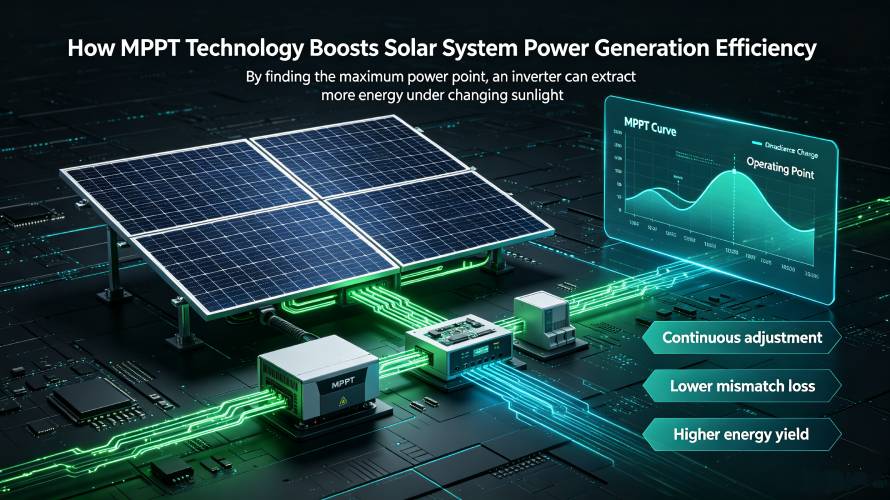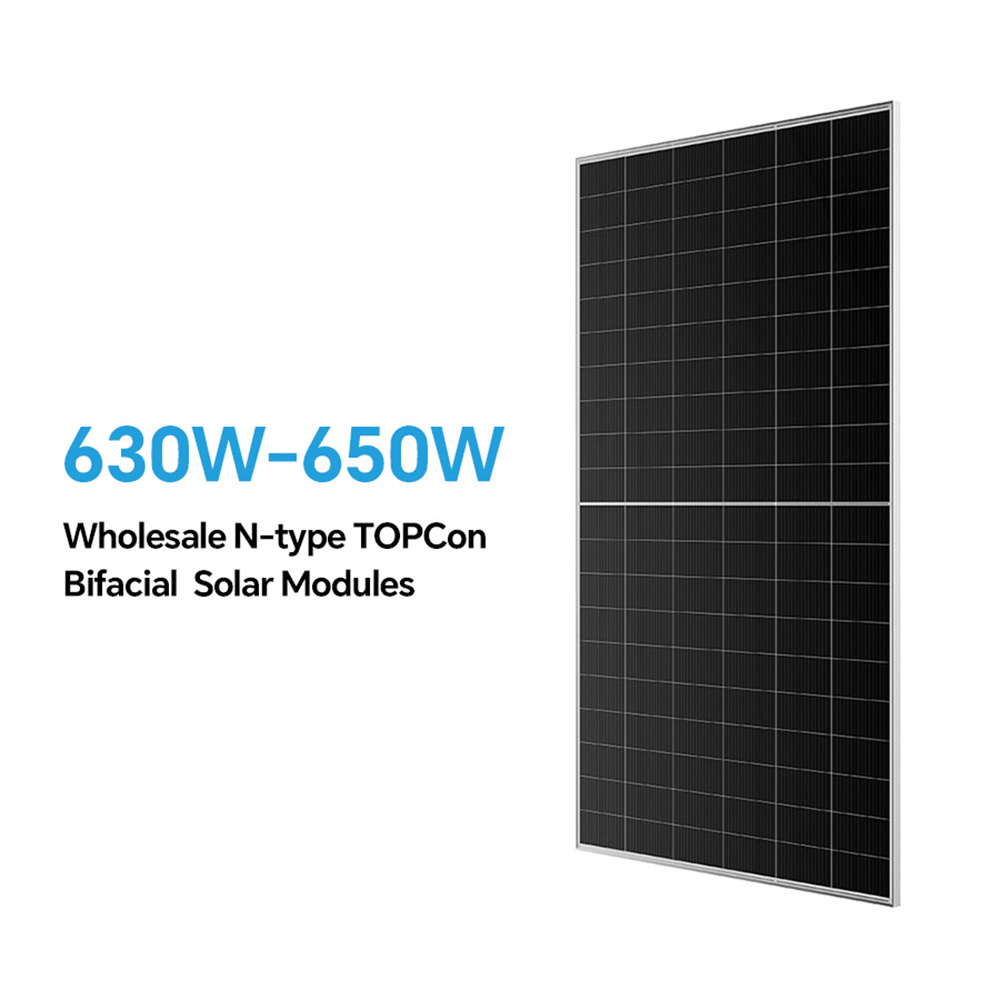
Executive Summary: Solar panel output fluctuates continuously due to changing solar irradiance, ambient temperature, and partial shading. Maximum Power Point Tracking (MPPT) technology uses advanced electronic algorithms and high-frequency DC-DC conversion to continuously locate the optimal voltage-current intersection ($P_{max}$). By matching the array's ideal operating point to the battery or inverter DC bus, MPPT increases overall solar power generation efficiency by 15% to 35% compared to legacy PWM controllers.
Solar modules have a non-linear $I-V$ (Current-Voltage) curve where maximum power occurs at a single point called the $V_{mp}$ (Voltage at Maximum Power). Standard charge controllers drag the panel down to the battery's lower voltage, wasting potential wattage. MPPT operates as an intelligent DC-DC converter, stepping down high PV voltage to charge voltage while boosting current to maintain maximum power ($P_{max} = V \times I$).
Solar irradiance changes instantly with passing clouds. Algorithms like Perturb & Observe (P&O) or Incremental Conductance continuously sweep $V_{mp}$ multiple times per second to guarantee peak power capture at all times.
Solar module voltage rises significantly in cold temperatures due to negative temperature coefficients ($V_{oc}$). MPPT converts this extra voltage boost into additional charging current rather than clipping it off like legacy systems.
When partial shading occurs, the $P-V$ curve forms multiple power peaks (local maxima vs. global maximum). Modern multi-MPPT algorithms perform full-curve scans to avoid getting trapped in false local peaks.
Because MPPT supports high input voltages ($V_{in} \gg V_{bat}$), power travels down long solar cable runs at lower current. This drastically reduces $I^2R$ resistance heat losses, preserving energy prior to reaching the battery bank or grid tie.
| Controller Technology | Energy Harvest Efficiency | System Voltage Support | Best Application Scenario |
|---|---|---|---|
| Direct Connection (Shunt) | 50% – 60% | Strict Matched Voltage Only | Ultra-low cost DIY, tiny solar toys |
| Standard PWM Controller | 65% – 75% | PV Voltage Must Equal Battery V | Small off-grid lighting (<200W) in warm climates |
| Single-Channel MPPT | 93% – 97% | High PV Strings (up to 150V–250V) | Residential energy storage, uniform solar arrays |
| Multi-Tracker MPPT Inverter | 98% – 99%+ | High PV Strings (up to 500V–1000V) | C&I rooftop arrays with multiple angles & complex shading |

 Monday -Sunday: 8:00 - 24:00
 No.13 Shang Zhen East RD., Taihe Town Baiyun Area, Guangzhou China
 info@futuregreenbattery.com