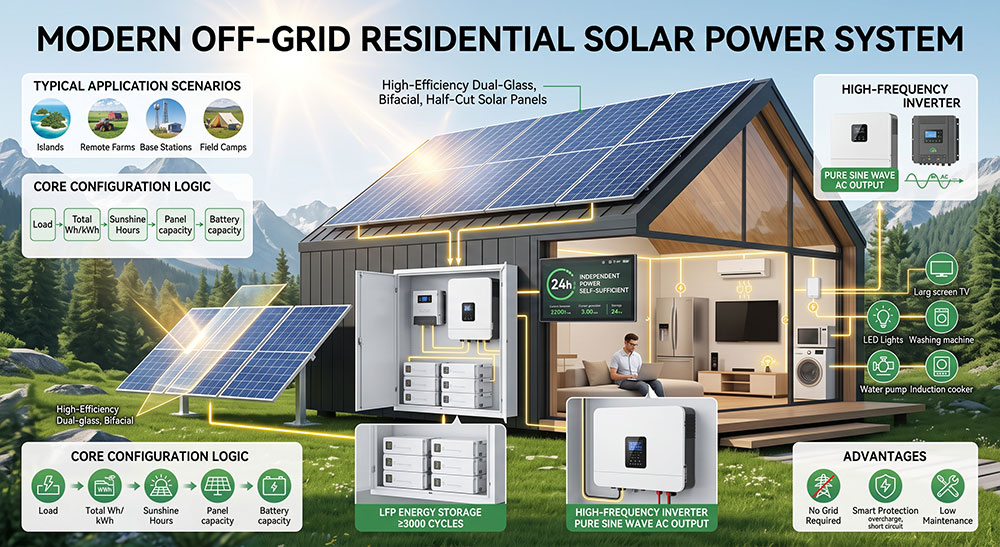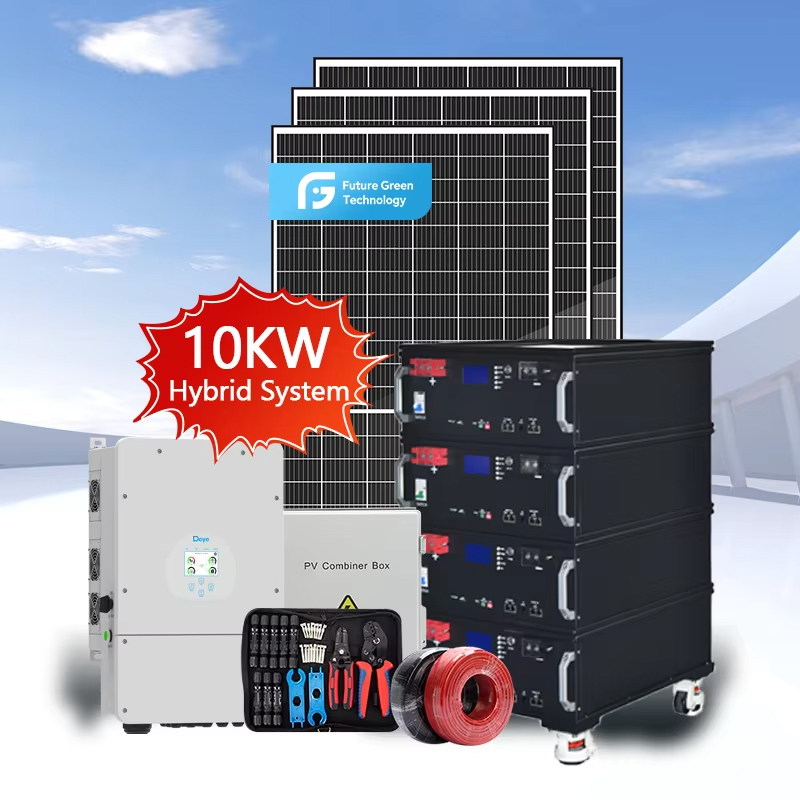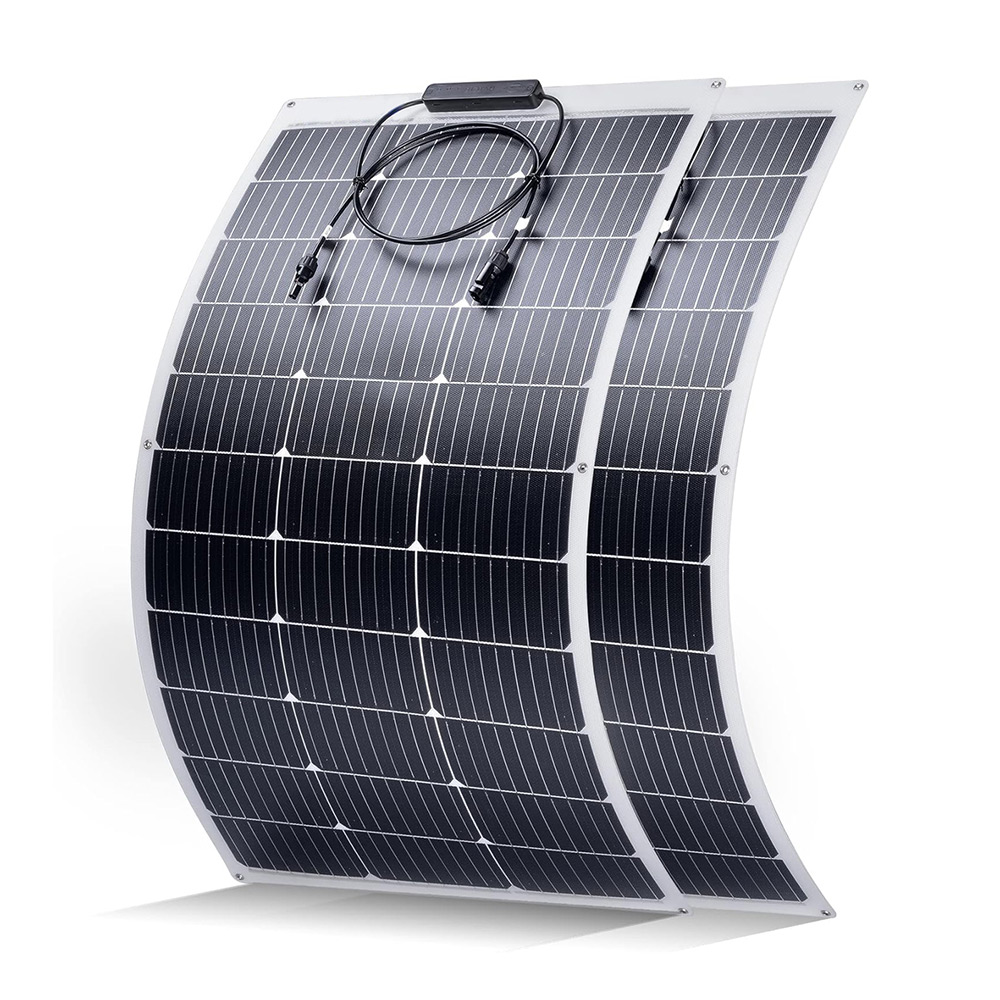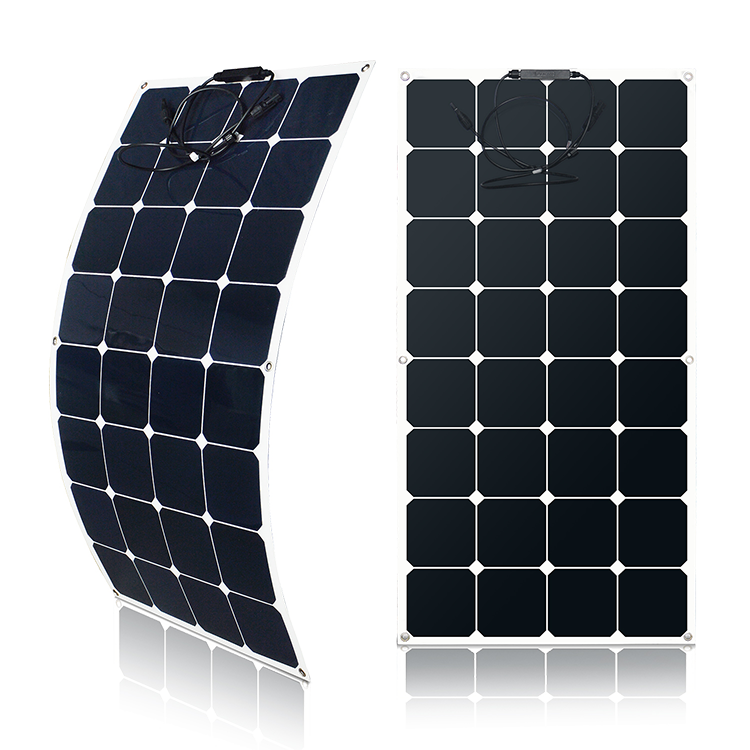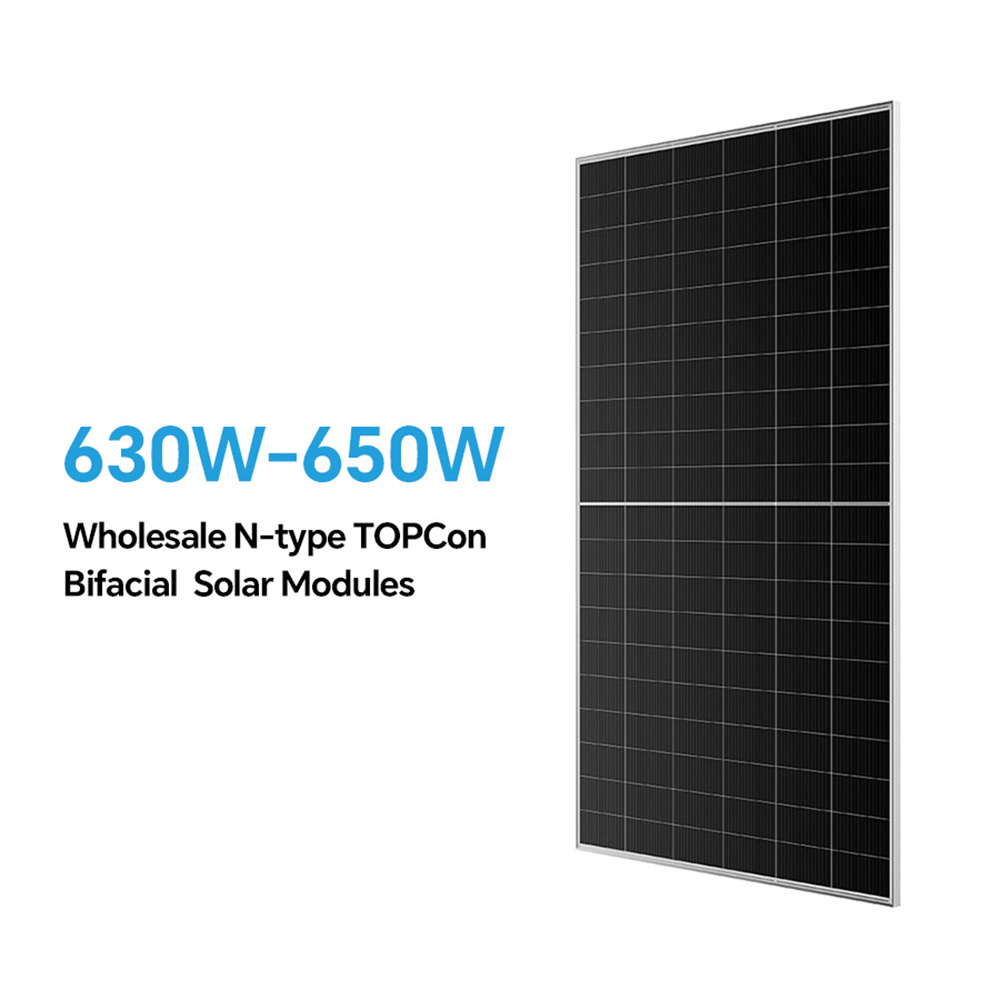
An off-grid photovoltaic and energy storage architecture functions as a self-sustaining microgrid. By orchestrating PV generation, lithium storage buffers, and inversion control, it guarantees uninterrupted AC power completely independent of public utilities.
Off-grid energy networks solve critical power deficits where utility line drops are either economically non-viable or geographically impossible:
Continuous 24-hour baseline power for living quarters completely detached from infrastructure lines.
Heavy inductive loads, automated irrigation pumps, electric fences, and remote cold storage.
Critical high-uptime loads requiring uninterrupted auxiliary storage with multi-day autonomy.
System sizing must avoid arbitrary approximations. Sizing follows a linear mathematical formula:
Array generation must satisfy real-time daily operational consumption while simultaneously providing adequate residual current to top off batteries by midday.
Lithium storage banks must account for 1 to 3 continuous low-irradiance or rainy days. LiFePO4 cells are deployed to support 80% to 90% Depth of Discharge.
| Parameter | Off-Grid Microgrid (DC-Coupled) | Grid-Tied Topology |
|---|---|---|
| Grid Connection | Zero grid connection required | Direct interconnect via Net-Meter |
| Outage Response | Full runtime (Unaffected by grid) | Automatic shutdown (Anti-islanding) |
| Storage Dependency | Mandatory LiFePO4 battery bank | Optional / Auxiliary |
| Primary Economics | Avoids extreme grid extension costs | Reduces recurring utility bills |
Inductive equipment (such as borehole pumps, compressors, and air conditioners) creates an inrush current reaching 300% to 500% of nominal wattage for several electrical cycles upon start. Inverters must feature at least a 2× nominal surge capability, or be oversized by 1.25–2.0× total connected load to prevent trip-offs.

 Monday -Sunday: 8:00 - 24:00
 No.13 Shang Zhen East RD., Taihe Town Baiyun Area, Guangzhou China
 info@futuregreenbattery.com